Your First Paycheck of 2027, State by State
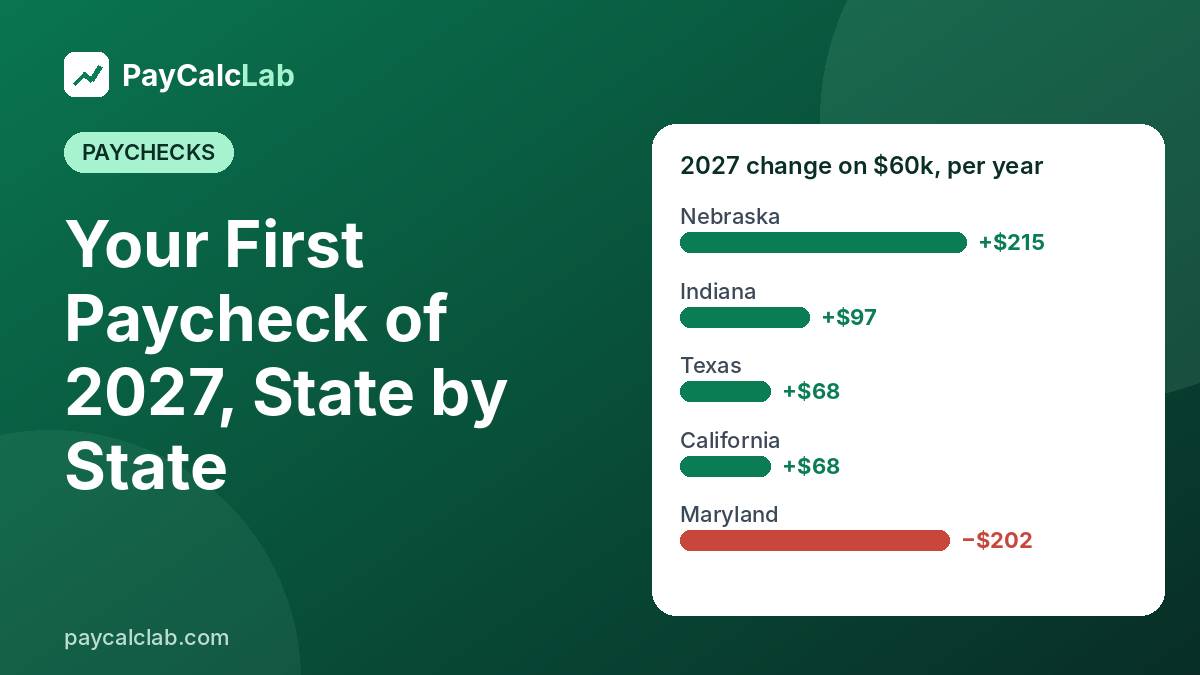
We calculated the first biweekly paycheck of 2027 in all 50 states and DC. On a $60,000 salary, the gap between the best and worst state is $4,420 a year. And in one state, workers will take home less in January than they did in December.
The quick takeaways
- Everyone gets the federal bump. New 2027 brackets add about $68 a year at $60,000 and $281 at $100,000 for single filers, in every state.
- Nebraska gains the most. Its top income tax rate drops from 4.55% to 3.99% on January 1, 2027, so a $60,000 worker keeps about +$215 more a year.
- Indiana trims its flat rate from 2.95% to 2.9%, and Montana cuts its top rate from 5.65% to 5.4% (that one only helps above about $63,000 of salary).
- Maryland is the exception. A new paid family and medical leave (FAMLI) deduction of up to 0.45% of wages starts with January paychecks, which outweighs the federal savings.
- The no-income-tax states still lead. Alaska, Florida, Nevada, New Hampshire, South Dakota, Tennessee, Texas and Wyoming top the list. Washington is slightly lower because of its paid leave and long-term-care payroll deductions, and North Dakota ties the leaders at $60,000 because its income tax only starts at higher incomes.
2027 take-home pay by state
Single filer, paid every two weeks, standard deduction, no 401(k) or health premiums. "Change" is the yearly difference versus the same salary under 2026 rules.
| State | $60k: per check | $60k: change/yr | $100k: per check | $100k: change/yr |
|---|---|---|---|---|
| Alaska | $1,941 | +$68 | $3,056 | +$281 |
| Florida | $1,941 | +$68 | $3,056 | +$281 |
| Nevada | $1,941 | +$68 | $3,056 | +$281 |
| New Hampshire | $1,941 | +$68 | $3,056 | +$281 |
| North Dakota | $1,941 | +$68 | $3,030 | +$281 |
| South Dakota | $1,941 | +$68 | $3,056 | +$281 |
| Tennessee | $1,941 | +$68 | $3,056 | +$281 |
| Texas | $1,941 | +$68 | $3,056 | +$281 |
| Washington | $1,941 | +$68 | $3,056 | +$281 |
| Wyoming | $1,941 | +$68 | $3,056 | +$281 |
| Ohio | $1,907 | +$68 | $2,980 | +$281 |
| Arizona | $1,891 | +$68 | $2,968 | +$280 |
| Louisiana | $1,886 | +$68 | $2,956 | +$281 |
| Vermont | $1,880 | +$68 | $2,897 | +$281 |
| Iowa | $1,878 | +$68 | $2,935 | +$280 |
| Rhode Island | $1,878 | +$68 | $2,935 | +$280 |
| New Mexico | $1,877 | +$68 | $2,919 | +$280 |
| Mississippi | $1,877 | +$68 | $2,930 | +$281 |
| Nebraska | $1,875 | +$215 | $2,929 | +$652 |
| Indiana | $1,875 | +$97 | $2,946 | +$330 |
| New Jersey | $1,873 | +$68 | $2,895 | +$281 |
| Pennsylvania | $1,870 | +$68 | $2,938 | +$281 |
| Wisconsin | $1,869 | +$68 | $2,905 | +$280 |
| Missouri | $1,868 | +$68 | $2,911 | +$281 |
| North Carolina | $1,868 | +$68 | $2,922 | +$280 |
| Colorado | $1,866 | +$68 | $2,914 | +$281 |
| West Virginia | $1,865 | +$68 | $2,907 | +$280 |
| Kentucky | $1,864 | +$68 | $2,926 | +$280 |
| Montana | $1,861 | +$68 | $2,895 | +$371 |
| Idaho | $1,861 | +$68 | $2,895 | +$281 |
| Arkansas | $1,859 | +$68 | $2,914 | +$280 |
| Oklahoma | $1,858 | +$68 | $2,904 | +$280 |
| Georgia | $1,854 | +$68 | $2,893 | +$280 |
| Michigan | $1,852 | +$68 | $2,902 | +$280 |
| California | $1,847 | +$68 | $2,811 | +$280 |
| South Carolina | $1,847 | +$68 | $2,870 | +$281 |
| District of Columbia | $1,846 | +$68 | $2,843 | +$280 |
| Alabama | $1,845 | +$65 | $2,899 | +$266 |
| Kansas | $1,843 | +$68 | $2,872 | +$280 |
| Connecticut | $1,843 | +$68 | $2,874 | +$281 |
| Minnesota | $1,842 | +$68 | $2,853 | +$281 |
| Virginia | $1,839 | +$68 | $2,866 | +$281 |
| New York | $1,839 | +$68 | $2,869 | +$281 |
| Delaware | $1,839 | +$68 | $2,854 | +$281 |
| Utah | $1,837 | +$68 | $2,883 | +$281 |
| Maryland | $1,835 | −$202 | $2,870 | −$170 |
| Massachusetts | $1,834 | +$68 | $2,872 | +$281 |
| Illinois | $1,832 | +$68 | $2,871 | +$280 |
| Maine | $1,830 | +$68 | $2,839 | +$280 |
| Hawaii | $1,824 | +$68 | $2,823 | +$281 |
| Oregon | $1,771 | +$68 | $2,752 | +$280 |
Federal tax uses IRS Rev. Proc. 2026-35 (2027). State tax uses current state rules plus the 2027 rate changes listed above. Local taxes (for example New York City, Philadelphia, Ohio cities, Maryland counties) are not included, and a few states still adjust their bracket thresholds for inflation in December, so treat figures within about $20 as a tie.
Why the ranking barely moves
Federal tax and payroll taxes are the same everywhere, so the order of states is driven almost entirely by state income tax. The 2027 federal change adds the same dollar amount in every state, which is why most states show an identical change. Only states with their own 2027 changes stand out.
What else can move your January check
Open-enrollment changes to health premiums, restarting 401(k) contributions and local tax changes often matter more than the tax tables. For the federal side, see will your paycheck be bigger in 2027.
Sources: IRS Rev. Proc. 2026-35; Social Security Administration 2027 COLA fact sheet; Nebraska Governor's office (3.99% rate for 2027); Indiana Department of Revenue and EY state withholding summary (2.9% for 2027); Montana legislation summarized by CBS News (5.4% top rate for 2027); Maryland Department of Labor (FAMLI 0.9% total contribution for 2027). Calculated with the PayCalcLab tax engine.
Frequently asked questions
Which state has the highest take-home pay in 2027?
The nine states without a wage income tax (Alaska, Florida, Nevada, New Hampshire, South Dakota, Tennessee, Texas, Washington and Wyoming) leave you the most. On $60,000, that's about $1,940 every two weeks for a single filer.
Which states cut income taxes in 2027?
Among confirmed changes: Nebraska's top rate falls to 3.99%, Indiana's flat rate to 2.9% and Montana's top rate to 5.4%, all on January 1, 2027.
Why is my Maryland paycheck smaller in 2027?
Maryland's FAMLI paid leave program starts payroll contributions in January 2027. Employees pay up to 0.45% of wages, about $4.50 on a $1,000 paycheck.