Will Your Paycheck Be Bigger in January 2027?
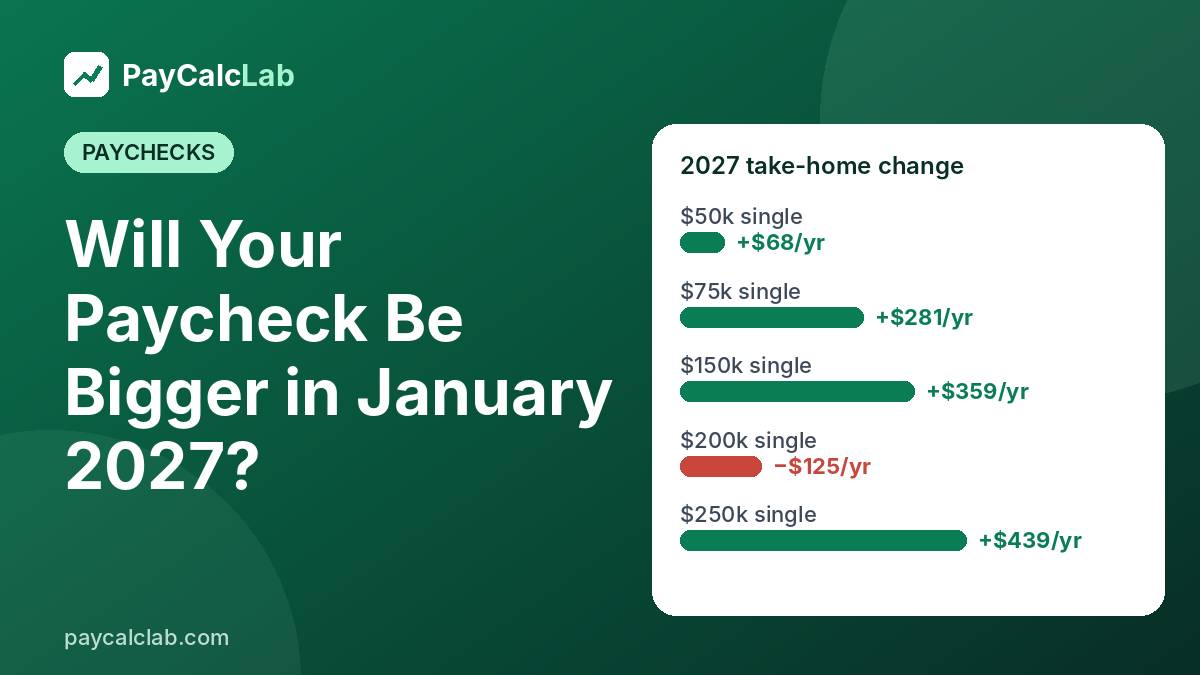
New 2027 tax brackets kick in with your first January paycheck. For most people that means slightly more take-home pay. But not for everyone: a single worker earning $200,000 will actually keep less in 2027, even with no change in salary.
The short answer
If your salary stays the same, your federal income tax goes down a little in 2027 because the IRS raised every bracket and the standard deduction for inflation. For most salaries we tested the gain is about $70 to $560 a year, or roughly $3 to $22 per biweekly paycheck. It's small, but it shows up automatically. You don't need to file anything.
The exception is people earning between roughly $184,500 and $210,000. The Social Security wage cap rises to $192,300, so more of their pay is hit by the 6.2% Social Security tax, and that extra tax can be bigger than the bracket savings.
Your 2027 paycheck vs 2026, by salary
Same salary in both years, standard deduction, federal income tax plus Social Security. State tax, benefits and 401(k) are left out so you can see the effect of the 2027 rules alone.
| Filing status | Salary | Federal tax change | Extra Social Security | Net change per year | Per biweekly check |
|---|---|---|---|---|---|
| Single | $35,000 | +$68 | $0 | +$68 | +$3 |
| Single | $50,000 | +$68 | $0 | +$68 | +$3 |
| Single | $75,000 | +$281 | $0 | +$281 | +$11 |
| Single | $100,000 | +$281 | $0 | +$281 | +$11 |
| Single | $150,000 | +$359 | $0 | +$359 | +$14 |
| Single | $200,000 | +$359 | −$484 | −$125 | −$5 |
| Single | $250,000 | +$923 | −$484 | +$439 | +$17 |
| Married jointly | $35,000 | +$100 | $0 | +$100 | +$4 |
| Married jointly | $50,000 | +$100 | $0 | +$100 | +$4 |
| Married jointly | $75,000 | +$136 | $0 | +$136 | +$5 |
| Married jointly | $100,000 | +$136 | $0 | +$136 | +$5 |
| Married jointly | $150,000 | +$561 | $0 | +$561 | +$22 |
| Married jointly | $200,000 | +$561 | −$484 | +$77 | +$3 |
| Married jointly | $250,000 | +$689 | −$484 | +$205 | +$8 |
Positive numbers mean more take-home pay in 2027. Calculated with PayCalcLab's tax engine using IRS Rev. Proc. 2025-32 (2026) and Rev. Proc. 2026-35 (2027) brackets.
Why the $200,000 earner loses money
In 2026 Social Security tax stops after the first $184,500 of wages. In 2027 it stops at $192,300. Anyone earning more than $184,500 pays 6.2% on that extra $7,800, which is up to $483.60 more a year. A single filer at $200,000 saves only about $359 from the new brackets, so the net result is roughly $125 less take-home pay. At $250,000 the bigger bracket savings win again.
There's a timing twist too: high earners stop paying Social Security tax partway through the year once they hit the cap, so their paychecks jump in the fall. In 2027 that jump comes a little later.
Five other things that can change your January paycheck
- Benefits premiums. Health, dental and vision costs chosen in open enrollment usually change on January 1. For many families this matters more than the tax change.
- 401(k) limit rises to $25,500. If you contribute a fixed percentage nothing changes. If you maxed out in 2026, your contributions restart in January, so your checks shrink until you hit the new limit. See the 2027 contribution limits.
- Maryland's new paid leave deduction. Starting January 2027, Maryland workers see a new FAMLI line on their pay stub: up to 0.45% of wages (about $4.50 on a $1,000 check). Benefits start in 2028.
- Minimum wage raises. Michigan goes to $15.00, Rhode Island to $17.00, Virginia to $13.75 and Washington to $17.73 on January 1. A full-time Michigan worker earns about $2,640 more a year. Full list: minimum wage by state 2027.
- Raises and W-4 changes. A raise or a new W-4 changes withholding right away. If you got a large refund last spring, January is a good time to adjust your W-4 so more money stays in each paycheck. See how to fill out a W-4.
Check your own first paycheck of 2027
The table above uses round salaries. Enter your exact pay, state and deductions in the paycheck calculator to see each line of your stub. Our calculators switch to 2027 rules in January. Until then, compare against the 2027 brackets.
Sources: IRS Revenue Procedure 2026-35 (2027 brackets and standard deduction), Social Security Administration 2027 COLA fact sheet ($192,300 wage base, 3.6% COLA), Maryland Department of Labor FAMLI contribution rate notice (0.9% total for 2027), state labor department minimum wage announcements. Figures are estimates for illustration.
Frequently asked questions
Will my paycheck go up in January 2027?
For most workers, slightly. If your salary doesn't change, the higher 2027 tax brackets and standard deduction cut federal income tax by roughly $70–$560 a year for the salaries we tested, or a few dollars per paycheck.
Why would my take-home pay go down in 2027?
The most common reasons are higher health insurance premiums from open enrollment, restarting 401(k) contributions, a new state deduction (like Maryland's FAMLI), or, for people earning about $185,000–$210,000, the higher Social Security wage cap.
Do I need to do anything to get the 2027 tax cut?
No. Employers update withholding tables automatically on January 1. You only need a new W-4 if your situation changed or you want different withholding.