New 401(k) Auto-Enrollment Rule: How Much Smaller Your Paycheck Gets
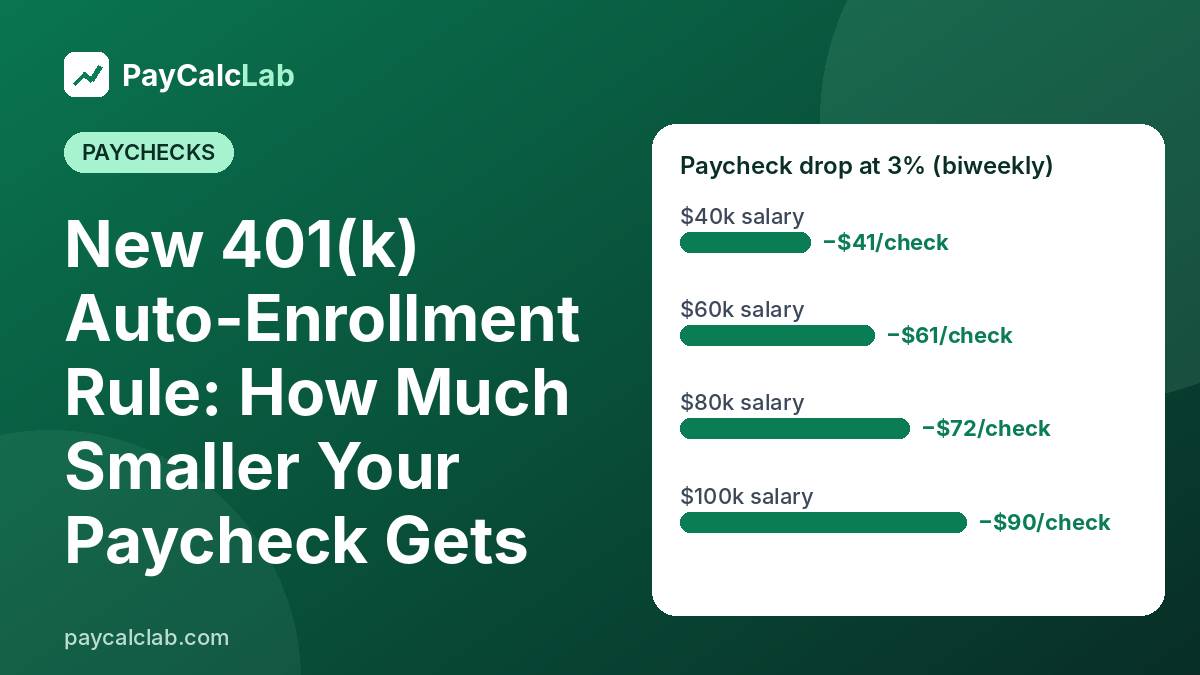
On November 17, 2026, the IRS finalized rules that make many 401(k) and 403(b) plans sign workers up automatically, starting at 3% of pay and rising every year. Most coverage stopped at the headline. Here's the part nobody calculated: how much smaller your paycheck actually gets. On a $60,000 salary, it's about $61 per biweekly check, not the $69 you might expect.
What the new rule says
- Automatic sign-up. Covered plans must enroll eligible employees automatically unless they opt out or pick a different rate.
- Starts at 3% of pay and goes up by at least 1 percentage point a year until it reaches at least 10%, with a 15% maximum.
- Timing. The final regulations generally apply to plan years starting after December 31, 2027, so most workers will see it in 2028. Some new plans already auto-enroll under the 2022 law.
- Who's covered. 401(k) and 403(b) plans created on or after December 29, 2022, when the SECURE 2.0 Act became law. Older plans are grandfathered.
- Who's exempt. Businesses with 10 or fewer employees, businesses less than three years old, government and church plans, and SIMPLE 401(k)s.
How much smaller each paycheck gets
Because 401(k) contributions come out before income tax, your take-home pay drops by less than the amount you save. Single filer, paid every two weeks, 2026 tax rules:
| Salary | 3% saved per year | Paycheck drop at 3% (TX) | At 3% (CA) | At 10% (TX) | At 10% (CA) |
|---|---|---|---|---|---|
| $40,000 | $1,200 | $41 | $39 | $135 | $129 |
| $60,000 | $1,800 | $61 | $57 | $203 | $189 |
| $80,000 | $2,400 | $72 | $64 | $240 | $215 |
| $100,000 | $3,000 | $90 | $79 | $300 | $264 |
Texas has no state income tax; California does, so the tax savings there are a bit bigger. Social Security and Medicare still apply to 401(k) contributions, which is why the drop isn't smaller.
What you get for it
If a $60,000 worker stays enrolled and the rate climbs from 3% to 10% over eight years, they'd put in about $43,200 over ten years. At a 7% average return, that could grow to roughly $55,700, before any employer match. Many employers match part of what you save, which is free money you only get if you contribute. Run your own numbers with the 401(k) calculator.
What to do when it hits your paycheck
- Check your first stub after enrollment. Look for a new "401(k)" or "403(b)" line.
- Find out the match. If your employer matches 4% and you're auto-enrolled at 3%, raising your rate to 4% may get you the full match.
- You can opt out or change the rate any time. Under the law, new auto-enrolled workers can generally ask for a refund of automatic contributions within 90 days of the first one.
- Re-check your budget each January, when the automatic 1% increase usually kicks in.
Want to see your exact take-home with any contribution rate? Enter your salary and 401(k) amount in the paycheck calculator.
Sources: IRS news release IR-2026-141 (Nov. 17, 2026) and final regulations under Internal Revenue Code §414A published in the Federal Register; SECURE 2.0 Act §101 as summarized by RSM, ADP and Thomson Reuters (grandfathering, small/new business exemptions, 90-day withdrawal). Paycheck figures calculated with the PayCalcLab tax engine; the growth projection assumes a flat salary and a 7% annual return and is illustrative only.
Frequently asked questions
Will I be automatically enrolled in a 401(k) in 2028?
If your employer's 401(k) or 403(b) plan was created on or after December 29, 2022, and the employer isn't exempt, the final IRS rules generally require automatic enrollment for plan years starting after December 31, 2027.
How much will 401(k) auto-enrollment take from my paycheck?
At 3%, about $41 per biweekly check on $40,000 and $90 on $100,000, after the income tax savings. The amount rises as the rate increases by 1% a year.
Can I opt out of automatic 401(k) enrollment?
Yes. You can opt out or choose a different rate. Newly auto-enrolled workers can generally withdraw automatic contributions within 90 days of the first one.